
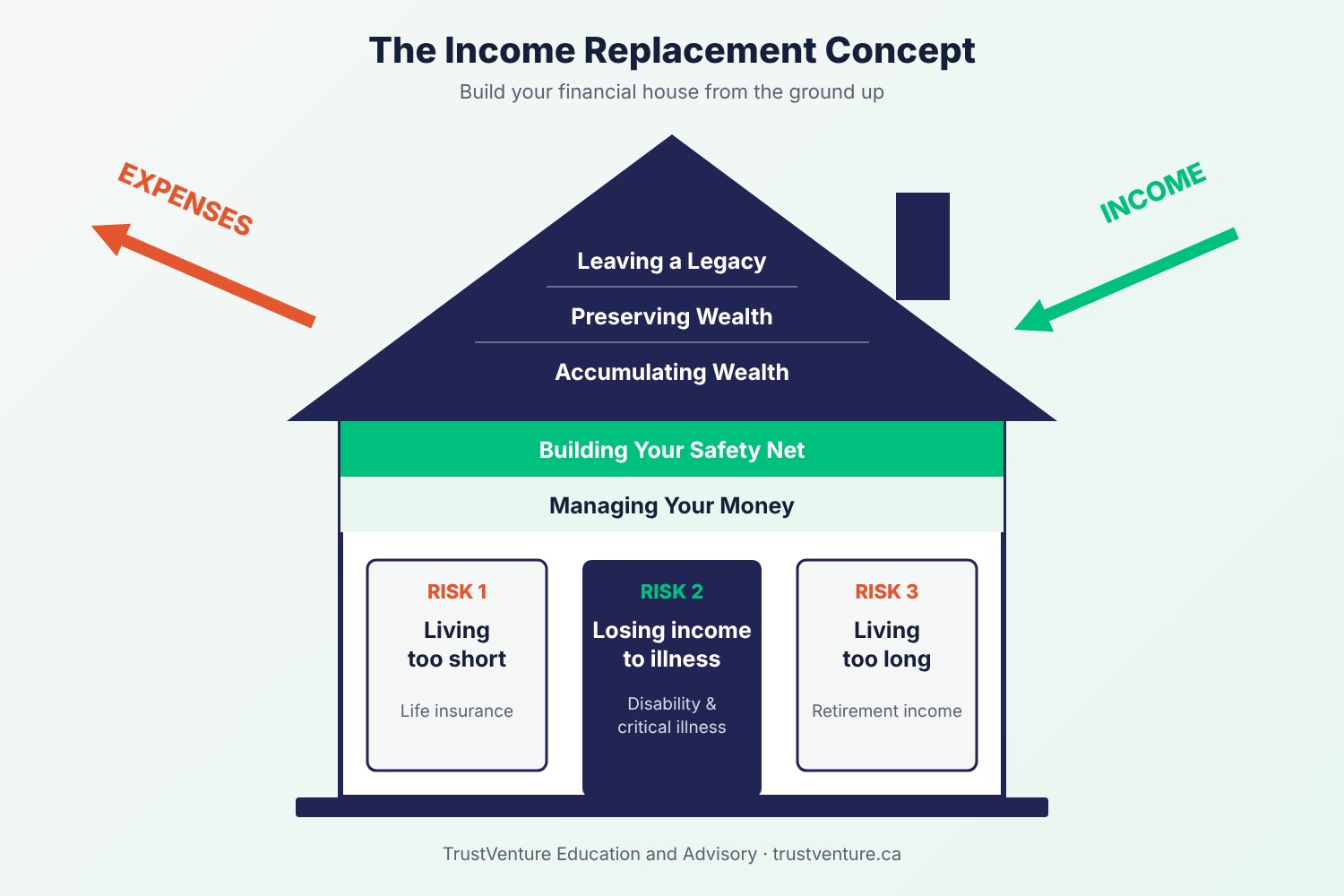
Your ability to earn an income is the engine behind everything you want for your family: the home, the children’s education, the retirement you are planning. A simple way to see how a financial plan protects that engine is to picture it as a house. This is often called the income replacement concept.
Money comes into the house as income and leaves as expenses. A good plan makes sure that, whatever happens, enough income keeps flowing in to cover what needs to go out.
The Foundation: Three Risks Every Family Faces
A house is only as strong as its foundation. In financial planning, the foundation is protection against three risks that can stop your income:
1. Living too short
If you pass away during your working years, your family loses your income, but the mortgage, bills, and plans remain. Life insurance replaces that income with a lump sum that is generally paid tax-free to your named beneficiaries, so your family can stay in their home and keep their plans on track.
2. Losing your income to illness or injury
This is the risk people most often overlook. A serious illness or injury can stop your paycheque for months or years while your expenses keep coming. Disability insurance replaces part of your income while you cannot work, and critical illness insurance pays a lump sum if you are diagnosed with a covered condition such as cancer, heart attack, or stroke.
3. Living too long
A long life is a good thing, as long as your money lasts as long as you do. Once you stop working, your savings, pensions, and government benefits have to replace your paycheque, possibly for 25 years or more. Retirement planning with RRSPs, TFSAs, RRIFs, and options like annuities or segregated funds helps turn your savings into income you cannot outlive.
Building the House, Floor by Floor
Once the foundation is protected, you can build upward. Each floor depends on the one below it.
Managing your money
The ground floor is your day-to-day finances: a realistic budget, a plan for paying down high-interest debt, and an emergency fund. Without this floor, every other goal is harder to reach.
Building your safety net
This is where the foundation’s protection is put in place: the right amounts of life, disability, critical illness, and health coverage, reviewed as your family and income change.
Accumulating wealth
With your income protected, you can invest with confidence. TFSAs, RRSPs, and other investments help your money grow toward your goals, such as a home, your children’s education, or retirement.
Preserving wealth
Growing your savings is only half the job. Preserving them means managing risk, keeping taxes efficient, and choosing products with protection features where they make sense, such as the maturity and death benefit guarantees of segregated funds.
Leaving a legacy
At the top of the house is what you leave behind: naming beneficiaries, planning for the taxes due at death, and in some cases using permanent life insurance so that more of what you built goes to the people and causes you care about.
Why the Order Matters
Many people start at the top, investing before they have protected their income or built an emergency fund. It feels like progress, but a single illness or loss can force them to sell investments at the wrong time or take on debt. Building from the ground up means a setback damages one room, not the whole house.
A Quick Self-Check
- If your income stopped tomorrow, how many months could your family cover its expenses?
- Would your family keep the home if something happened to you?
- Do you have coverage if illness keeps you from working, beyond what your employer provides?
- Do you know roughly how much income you will need in retirement, and where it will come from?
- Have you named beneficiaries on your registered accounts and insurance policies?
If any answer is “I am not sure,” that is the part of your house to work on first.
Want to see how your own financial house stands? Book a free, no-obligation consultation with one of our advisors, in English or Farsi.
This article is for general educational purposes only and is not personalized financial, tax, or legal advice. Insurance and segregated fund products are offered through Crius Financial Services.